
Email verification to prevent fraud (2025 guide)
Learn how OTP email verification prevents multi-accounting, ATO and hyper-disposable emails in 2025. Practical, technical guide with Didit.
Key takeaways (TL; DR):
Email remains the #1 fraud vector in 2025.
Hyper-disposable domains are growing and undermining traditional controls.
OTP verification cuts multi-accounting and ATO risk from onboarding.
Didit lets you add email verification in minutes via Workflows or API.
Email is the most widely used identifier on the internet—and the most attacked. In 2024, the FBI recorded $16.6B in cybercrime losses (+33% YoY), with email at the center of many reported incidents (source). Add to that hyper-disposable domains, which are created and burned in days and already represent a substantial share of sign-up attempts: roughly 46% of high-risk disposable domains are hyper-disposable (AtData). Bottom line: if your business runs on onboarding and trust, modern email verification—fast, measurable, and consistent—becomes indispensable to protect growth and core metrics.
If you lead compliance or run a fintech/marketplace, this guide helps you harden sign-ups and credential changes without wrecking conversion: what to watch, when to verify, and how to deliver a clean UX.
Why email is today’s first line of defense against fraud
Email shows up at every critical moment of the customer journey: sign-up, account recovery, credential changes, security notices, and transactional flows. When the address is verified early (during onboarding) and periodically (especially as risk profiles change), the attack surface drops dramatically. Plus, verified emails improve your email marketing strategy by boosting deliverability, reducing bounces, and improving traceability.
2024–2025 landscape: attacks, losses, and common vectors
Recent reports highlight three email-driven fraud vectors:
- Phishing and spoofing. Rising activity, with campaigns using malicious QR codes or fake login pages.
- Business Email Compromise (BEC). Attackers impersonate executives or legal reps to steal funds/data. IC3 estimates BEC losses at ~$2.77B.
- Personal data breaches. Many stem from a compromised email and caused ~$1.45B in losses.
The impact on compliance and operational risk
Email verification strengthens KYC controls by proving the person attempting verification actually controls the declared mailbox, reducing sign-ups with borrowed, stolen, or incomplete data. It also powers risk-based authentication: if context looks abnormal, ask for an extra step; and it improves auditability via clearer evidence trails. Evidence shows these controls materially reduce account compromise.
Verification vs. validation: differences that truly affect risk
Before diving in, one key nuance: email OTP proves mailbox ownership at that moment, but doesn’t by itself tell you whether an address is disposable or hyper-disposable. That’s why it works best combined with validation and reputation signals (format, MX/SMTP, domain age/category, breach exposure). With that context, OTP verification delivers speed and ownership certainty; validation improves channel hygiene and helps decide when to ask for OTP.
When we talk about email security controls, two complementary goals matter:
- Ownership verification: send a one-time code (OTP) to ensure the person controls the inbox. This directly impacts Account Takeover and multi-accounting fraud while preventing a stolen email from becoming a recovery channel for future intrusions.
- Validation and deliverability: check syntax and protocols to ensure the destination mailbox is healthy. This filters non-existent or inactive addresses that could be used to game metrics.
This multilayer approach lets organizations confirm email ownership in seconds via OTP while also improving deliverability through a healthy mailbox.
Disposable and hyper-disposable emails
A disposable (or temporary) email is a short-lived mailbox (minutes, hours, or a few days), designed to register without exposing a real address. Some services generate addresses instantly and even display messages publicly. The result? They can receive verification emails and disappear afterwards.
The 2025 trend is hyper-disposable email, with domains that spin up and burn down at high speed. Data suggests ~46% of high-risk disposable domains are already hyper-disposable, multiplying churn and breaking any defense that relies solely on lists.
The problems these emails create
- Fake accounts at scale. They enable account farms for bonus abuse, scraping, or internal spam. Each address lives just long enough to pass basic registration and then “dies.”
- Evasion of static controls. Rapid rotation of hyper-disposable domains makes outdated blocklists ineffective.
- Deliverability and distorted metrics. Higher bounce rates, spam-sender reputation issues, and other signals that harm deliverability for critical notifications (including OTP).
Does OTP verification help with temporary emails?
Yes—but with limits. Email OTP verifies ownership of the mailbox at that instant and, by itself, won’t tell you if the address is disposable or legitimate. Still, OTP is pivotal in the customer journey and helps mitigation when combined with risk signals (validation, reputation, disposable detection) and adaptive routes.
Event-based re-verification
You don’t need to re-verify every user all the time: do it when context changes and/or risk rises. The idea is to trigger an extra step only at critical moments—e.g., withdrawals or password changes—using factors like email verification or biometrics. That way you harden sensitive points without punishing everyone.
How Didit works: email verification
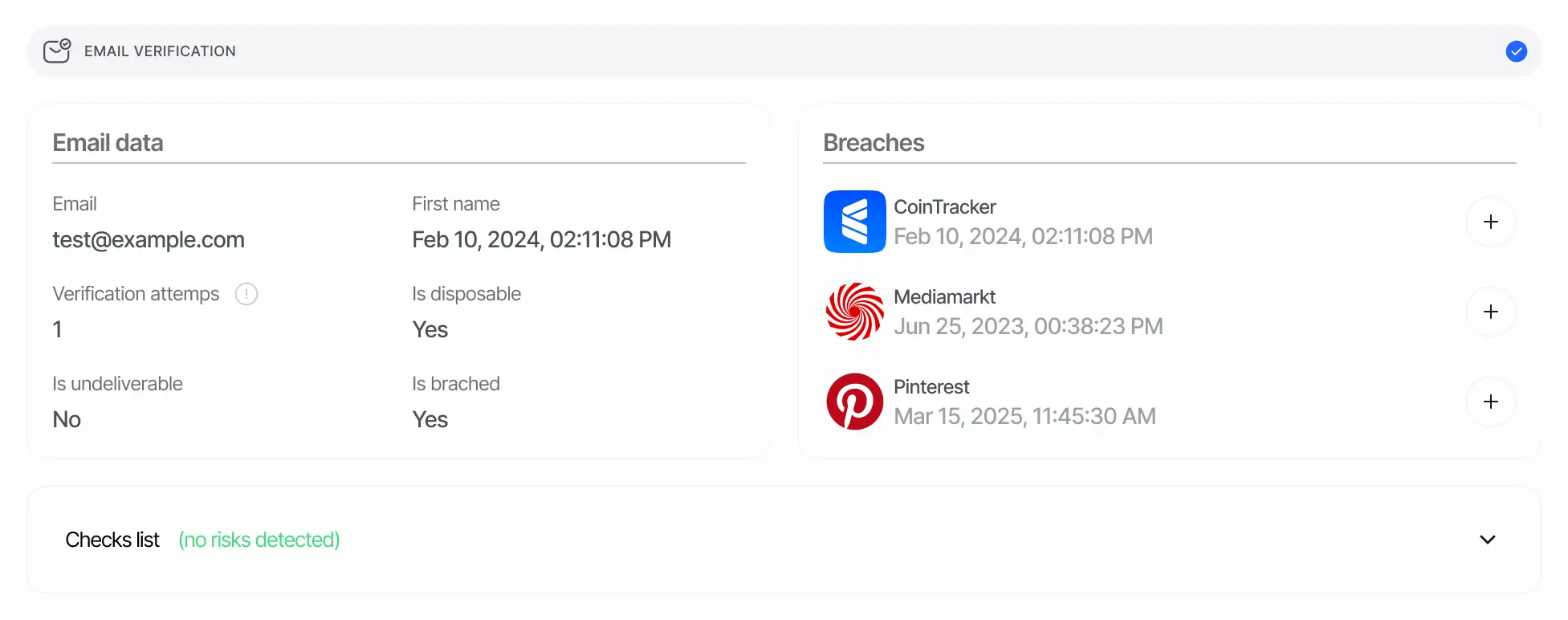
Didit’s email verification confirms ownership of an address using a one-time passcode (OTP) sent to the user’s inbox. It can be used inside identity verification flows or as a standalone control, and integrates via no-code Workflows or API.
Results are delivered via webhooks and a dashboard with decision states and reasons, streamlining audits.
Learn more in the Didit email verification technical docs.
Basic flow (step by step)
- Start the verification. Create a verification session (from a Workflow or via API) and send the user the link/QR to complete the email step.
- Send and validate the OTP. The user receives a one-time code, enters it within a timed window, and you approve or deny based on the result.
- Receive the result. Webhooks notify outcomes and the dashboard reflects verification status. If part of a broader flow, determine next steps accordingly.
Integration: Workflows vs. API
- Verification links (no-code Workflows). Ideal to launch in minutes, orchestrate steps, and define routes for different risk profiles.
- API integration. Offers more flexible control over email verification.
When to run Didit’s email verification
You can verify emails at different stages of the customer journey:
- Onboarding: prove ownership with low friction before asking for more sensitive attributes.
- Credential changes: send an email OTP to modify account details.
- High-risk operations: withdrawals, payments, or payout-method changes.
- Account recovery: a secure loop closure when email is the primary channel.
Conclusion
In 2025, email isn’t just a communication channel—it’s a critical control point. Smart OTP verification helps stop fraud before it happens and strengthens digital trust. With Didit, adding email verification takes minutes: Workflows or API, results and reasons via webhooks and dashboard, and audit-ready traceability.
Related articles
- Unico Partners with Didit to Expand Access to State-of-the-Art Identity Verification for SMEs in Brazil
- Didit Closes $7.5M Seed to Build the Infrastructure for Identity and Fraud
- Non-Document Verification in Singapore: MyInfo-Based KYC Without Document Uploads
- Non-Document Verification in Canada: Credit Bureau-Based KYC Without Document Uploads
- Non-Document Verification in the United States: SSN-Based KYC Without Document Uploads
- Non-Document Verification in France: KYC Without Document Uploads