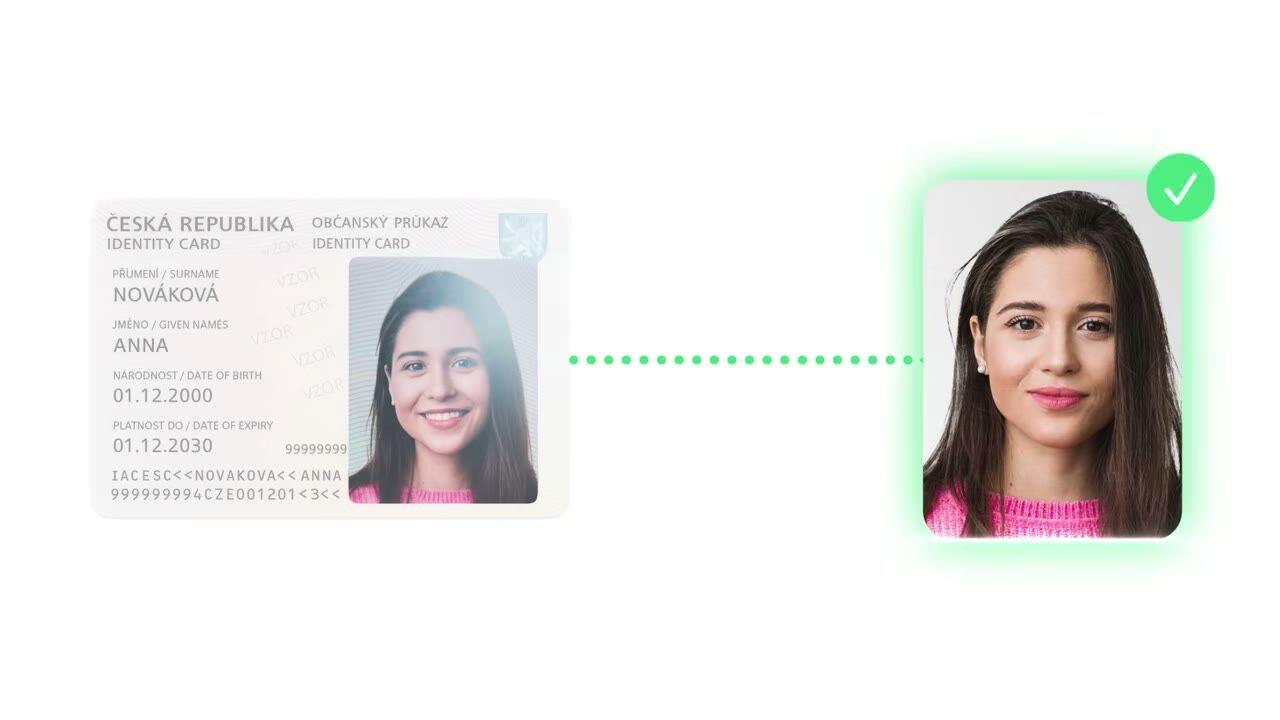
Confirm the person on camera matches the photo on their ID. Sub-second verdict. $0.05 per check, 500 free/month, or bundled into a $0.33 full KYC (know your customer).
Sub-2-second similarity score with anti-spoof fallback. $0.05 per check — the
cheapest face-match comparison on the market.
How it works
From sign-up to verified user in four steps.
Step 01
Create the workflow
Pick the checks you want — ID, liveness, face match, sanctions, address, age, phone, email, custom questions. Drag them into a flow in the dashboard, or post the same flow to our API. Branch on conditions, run A/B tests, no code required.
Step 02
Integrate
Embed natively with our Web, iOS, Android, React Native, or Flutter SDK. Redirect to a hosted page. Or just send your user a link — by email, SMS, WhatsApp, anywhere. Pick what fits your stack.
Step 03
User goes through the flow
Didit hosts the camera, the lighting cues, the mobile hand-off, and accessibility. While the user is in the flow, we score 200+ fraud signals in real time and verify every field against authoritative data sources. Result in under two seconds.
Step 04
You receive the results
Real-time signed webhooks keep your database in sync the moment a user is approved, declined, or sent to review. Poll the API on demand. Or open the console to inspect every session, every signal, and manage cases your way.
Built for developers · Built against fraud · Open by design
Six capabilities. One feature flag. FACE_MATCH.
Every capability below is a toggle on the same module. No upsell tiers, no separate SKUs, no add-on calls. Switch Face Match on per workflow, or call the standalone endpoint directly.
Face Match closes the loop between the document a user uploaded and the person in front of the camera. Inside a KYC (know your customer) session it runs automatically against the ID portrait. Standalone, you pass two images — source and target — and we return a similarity score.
Same person check
source_image · target_image
Matched
Live selfie
ID portrait
Similarity 87%
Face detected · both images
Embedding compared
Pose · lighting normalized
One identity bound
02 · Similarity score
One score. Zero to one hundred.
Every match returns a 0–100 similarity score, the two image URLs, and a session reference binding the result back to the verification that produced the selfie. Persist the score and status; the image URLs expire after 60 minutes so you store only what your audit policy requires.
face_match · response
POST /v3/face-match/
200 OK
87
score · 0–100
statusApproved
score87
source_imagehttps://…/selfie.jpg
target_imagehttps://…/portrait.jpg
source_sessionses_3daf4c64…
03 · Sub-second inference
Under a second on standard hardware.
Edge-served face-embedding model. No model download, no on-device acceleration assumption, no degraded experience on entry-level Android. Same engine and latency whether you go through the hosted workflow UI or the standalone endpoint. Robust to pose, lighting, hairstyle, glasses, and normal ageing.
Inference
Edge-served · embedding model
Live
0.62s
p50 latency
0.94s
p99 latency
200ms
model only
Robust to pose
Robust to lighting
Hairstyle · glasses tolerated
Normal-window ageing
04 · Tunable thresholds
Decide. Review. Approve. Per score band.
The one configurable warning — low similarity — maps to two thresholds you set per application. Below the decline threshold auto-declines; in between routes to manual review; above the review threshold auto-approves. The one auto-decline trigger (no reference image) stays enforced by us no matter what.
Risk policy
LOW_FACE_MATCH_SIMILARITY
4 bands
Score bandAction
Below 40 · low similarity
Decline
40 – 60 · borderline
Review
Above 60 · clean match
Approve
No reference image
Decline
05 · Modular by design
Toggle on any workflow. Without rewriting capture.
Face Match is a feature flag on the same workflow builder as ID Verification, Liveness, and AML (anti-money laundering). Add it to an existing onboarding flow and the next session picks it up — no SDK upgrade, no new capture screen, no separate webhook. Remove it and the rest of the flow keeps running.
Workflow builder
wf_face_match_kyc
On
01
ID Verif.
02
Liveness
03
FACE_MATCH
04
AML
FACE_MATCH
ID_VERIFICATION
LIVENESS
AML
06 · Transparent pricing
$0.05 per match. 500 free every month. No SKU.
$0.05 for every standalone Face Match call. Bundled inside a full KYC workflow with ID Verification, Liveness, and Device & IP Analysis, the session ships at a flat $0.33 — Face Match included. The first 500 verifications/month are free on every account, forever. No monthly minimum, no platform fee, no SKU to negotiate.
Billing
Pay per success · no minimum
Live
Standalone face matchPOST /v3/face-match/
$0.05
Bundled in full KYCID + Liveness + Match + IP
$0.33
Free monthly tierEvery account · forever
500
Platform feeNo minimum
$0
Invoice fired · 487 of 500 free matches usedthis month
Integrate
Two endpoints. Same JSON. Same price.
Create a session when you want our hosted UI to capture the selfie and pull the reference portrait from the same session's ID. Call the standalone endpoint when you already have both images. Both return the same face_match report.
You pass the pair. We return the score inline.docs →
Agent-ready integration
Ship Face Match in one prompt.
Paste the block below into Claude Code, Cursor, Codex, Devin, Aider, or Replit Agent. Fill in the my_stack placeholder with your framework, language, and use case. The agent provisions Didit, builds the workflow with Face Match enabled, wires the webhook, and ships.
didit-integration-prompt.md
# Didit Face Match 1:1 — integrate in 5 minutes
You are integrating Didit's Face Match 1:1 (selfie vs. reference image)
module into <my_stack>. Follow these steps exactly. Every URL, header,
and enum value below is canonical — do not paraphrase or "improve" them.
## 1. Provision an account
- Sign up: https://business.didit.me (no credit card required).
- Or provision programmatically: POST https://apx.didit.me/auth/v2/programmatic/register/
(returns an API key bound to the workspace + application).
## 2. Two integration paths — pick one
### Path A — Workflow Builder (hosted UI)
Best when you want Didit to handle selfie capture, real-time framing,
mobile handoff, and accessibility for you. Inside a Know Your Customer (KYC) workflow,
Face Match runs automatically against the portrait extracted from the
ID document the user uploads in the same session.
1. Create a workflow that contains the FACE_MATCH feature:
POST https://verification.didit.me/v3/workflows/
Authorization header: x-api-key: <your-api-key>
Body: workflow_label, features array with FACE_MATCH plus any
other features the same session needs (typically
ID_VERIFICATION and LIVENESS for full KYC). Feature names
are UPPERCASE — strict enum.
Optional config: review_threshold and decline_threshold for the
LOW_FACE_MATCH_SIMILARITY warning (numbers 0–100).
2. Create a verification session for an end user:
POST https://verification.didit.me/v3/session/
Body: workflow_id (from step 1), vendor_data (your own user id).
Response: session_url — redirect the user to it.
3. Listen for webhook callbacks (see "Webhooks" below).
### Path B — Standalone server-to-server API
Best when you already have two face images and just need a similarity
score (re-auth at sensitive actions, employee badge access, cross-app
identity binding, periodic re-verification).
POST https://verification.didit.me/v3/face-match/
Content-Type: multipart/form-data
Body fields:
- source_image (required, file — the live selfie)
- target_image (required, file — the reference image, e.g. ID portrait
or a stored enrollment frame)
- vendor_data (optional string, your user id)
Response: synchronous JSON report with the similarity score and warnings
array. No webhook needed.
## 3. Webhooks (Path A only — Path B returns synchronously)
- Register a webhook destination once via
POST https://verification.didit.me/v3/webhook/destinations/
Body: url, subscribed_events: ["session.verified",
"session.review_started",
"session.declined"]
- Response includes secret_shared_key — store it.
- Every webhook delivery carries an X-Signature-V2 header you MUST verify
before trusting the payload. HMAC-SHA256 verification MUST run against the raw body bytes (the raw payload as Didit sent it) BEFORE any JSON parsing — re-serialising the parsed body changes whitespace and key order, which invalidates the signature.Algorithm:
1. sortKeys(payload) recursively
2. shortenFloats (truncate trailing zeros after the decimal point)
3. JSON.stringify the result
4. HMAC-SHA256 with the secret_shared_key
5. Hex-encode, compare to the X-Signature-V2 header.
## 4. Reading the report (both paths return the same shape)
The face_match object includes:
- status: "Approved" | "Declined" | "In Review" | "Not Finished"
- score: number 0-100 (normalized similarity score)
- source_image_session_id: the verification session that produced the
live selfie (Path A) or null (Path B)
- source_image: signed URL to the live selfie (expires in 1 hour)
- target_image: signed URL to the reference image (expires in 1 hour)
- warnings: Array<{ risk, log_type, short_description, long_description }>
Auto-decline risks (always enforced by Didit, not configurable):
- NO_REFERENCE_IMAGE (no reference image available to compare against)
Configurable risks (action per workflow — Decline, Review, or Approve):
- LOW_FACE_MATCH_SIMILARITY
Tune two thresholds per application:
review_threshold → score below this goes to "In Review"
decline_threshold → score below this is auto-declined
## 5. Hard rules — do not change
- Base URL for /v3/* endpoints is verification.didit.me (NOT apx.didit.me).
- Feature enum is UPPERCASE: FACE_MATCH, ID_VERIFICATION, LIVENESS, AML, IP_ANALYSIS.
- Auth header is x-api-key (lowercase, hyphenated).
- Webhook signature header is X-Signature-V2 (NOT X-Signature).
- Always verify webhook signatures before trusting payload data.
- Status casing matches exactly: "Approved", "Declined", "In Review",
"Not Finished" (title-cased, space-separated).
- Reference and source image URLs in the response expire in 60 minutes.
Persist only the score and status; re-fetch images on demand if your
audit policy needs them.
## 6. Pricing reference (public)
- Standalone POST /v3/face-match/: $0.05 per match.
- Bundled inside a full KYC workflow with ID Verification + Passive
Liveness + Device & IP Analysis: $0.33 per session (Face Match included).
- 500 free checks every month, forever, on every account.
## 7. Verify your integration
- Sandbox starts on signup at https://business.didit.me — no separate flag.
- Test images: deterministic synthetic faces returned in sandbox
(Approved by default; trigger Declined by sending a mismatched pair).
- Switch to live: flip the application's environment toggle in console.
When in doubt: https://docs.didit.me/core-technology/face-match/overview
Open a new country in one click. We do the hard work.
We open the local subsidiaries, secure the licenses, run the penetration tests, earn the certifications, and align with every new regulation. To ship verifications in a new country, flip a toggle. 220+ countries live, audited and pen-tested every quarter — the only identity provider an EU member-state government has formally called safer than in-person verification.
Verifications free every month, forever, on every account.
Three tiers, one price list
Start free. Pay per usage. Scale to Enterprise.
500 free verifications every month, forever. Pay-as-you-go for production. Custom contracts, data residency, and SLAs (Service Level Agreements) on Enterprise.
Free
Free
$0 / month. No credit card required.
Free KYC bundle (ID Verification + Passive Liveness + Face Match + Device & IP Analysis) — 500 / month, every month
Blocklisted Users
Duplicate Detection
200+ fraud signals on every session
Reusable KYC across the Didit network
Case Management Platform
Workflow Builder
Public docs, sandbox, SDKs, MCP (Model Context Protocol) server