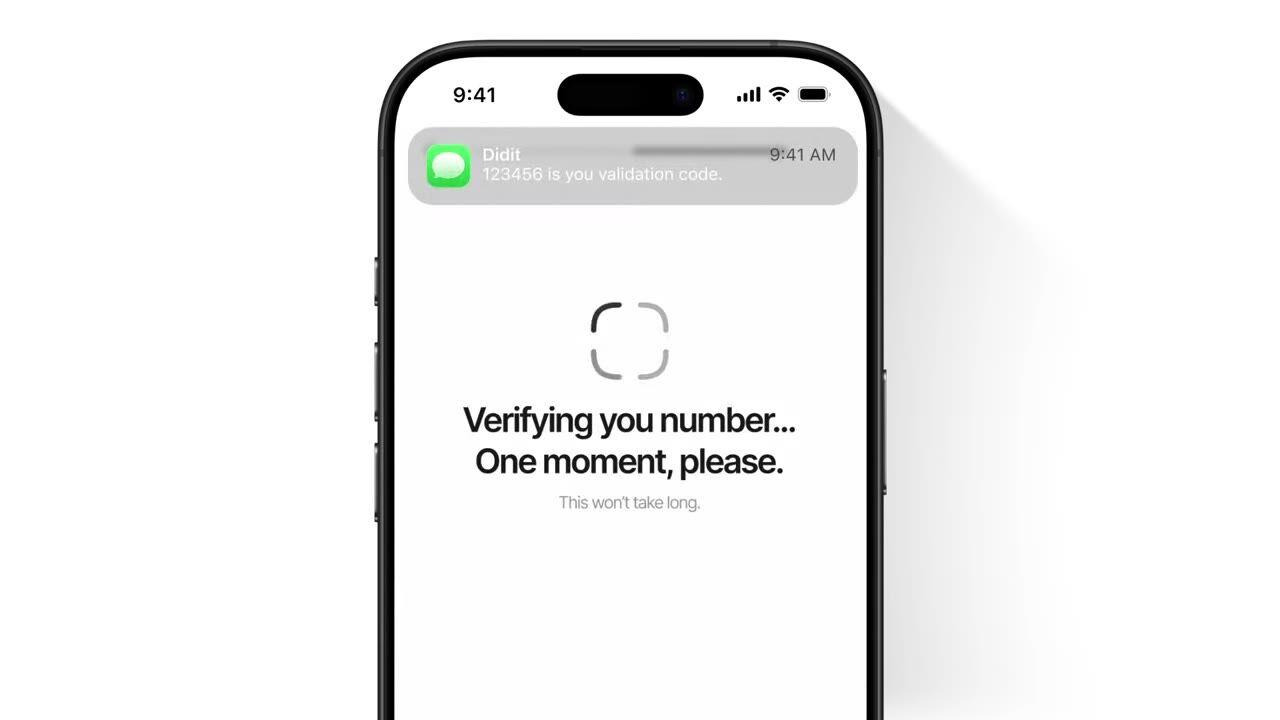
Send a one-time code over SMS, WhatsApp, Telegram, RCS, or voice, whichever channel the user actually answers. Auto-fallback between channels, with carrier-risk scoring on every call. From $0.03 plus carrier.
One module, five delivery rails. We retry across channels until the code
lands, score SIM-swap and carrier risk on every call, and bill from $0.03 plus
carrier, same workflow either way.
How it works
From sign-up to verified user in four steps.
Step 01 / 04
01
Create the workflow
Pick the checks you want, ID, liveness, face match, sanctions, address, age, phone, email, custom questions. Drag them into a flow in the dashboard, or post the same flow to our API. Branch on conditions, run A/B tests, no code required.
Integrate
Embed natively with our Web, iOS, Android, React Native, or Flutter SDK. Redirect to a hosted page. Or just send your user a link, by email, SMS, WhatsApp, anywhere. Pick what fits your stack.
User goes through the flow
Didit hosts the camera, the lighting cues, the mobile hand-off, and accessibility. While the user is in the flow, we score 200+ fraud signals in real time and verify every field against authoritative data sources. Result in under two seconds.
You receive the results
Real-time signed webhooks keep your database in sync the moment a user is approved, declined, or sent to review. Poll the API on demand. Or open the console to inspect every session, every signal, and manage cases your way.
Built for developers · Built against fraud · Open by design
Six capabilities. One feature flag. PHONE.
Every capability is a toggle on the same module. No upsell tiers, no separate plans, no add-on calls. Switch them on per workflow in the console or pass them inline on the API call.
SMS, WhatsApp, Telegram, RCS, and voice, all on the same module and workflow. Pin a channel when policy demands (regulator-mandated SMS, WhatsApp-first markets like Brazil and India), or let us pick the cheapest deliverable hop.
One feature flag · Five channelsfeature: PHONE
SMSDefault
WhatsAppBR / IN / MX
TelegramEU
RCSAndroid
VoiceFallback
02 · Routing
Automatic channel fallback when one fails.
Carrier SMS blocks, premium-rate countries, and silent failures are routed past automatically. We retry on the next deliverable channel without your code touching anything, and tell you which channel actually delivered.
Auto channel routingPOST /v3/phone/send/
1SMSCarrier blocked
2WhatsAppDelivered
verification_methodwhatsapp
03 · Coverage
Global telco reach. Carrier-aware delivery.
Multi-carrier integrations per country, with routing tuned to local habits, WhatsApp leads in Brazil, India, and Mexico, Telegram and RCS lead across the EU, SMS leads in the US. Country, carrier, and number type are detected automatically.
04 · Fraud signals
More than a one-time code. Carrier risk on every call.
Every verification returns the carrier name and type (mobile, landline, voice over IP), flags for disposable and virtual numbers, and explicit warnings for high-risk, duplicated, or blocklisted numbers. Decide, review, or approve per risk category.
05 · Conversion
SMS-only leaks users. Multi-channel keeps them.
When SMS fails, carrier filter, roaming, dead zone, deliverability decline, single-channel providers leave users staring at a never-arriving code. We recover them on the next hop, and report which channel delivered so you can tune routing with real data.
Completion · 30-day rollingHigher is better
SMS only58%
+ WhatsApp79%
+ Voice fallback93%
Illustrative, directional, not a study.
06 · Pricing
Pay per message. From $0.03 plus carrier.
$0.03 per verification, plus a country and channel carrier fee passed through with no markup. You only pay when a message is sent, abandons before delivery cost nothing.
Per-message ratesFrom $0.03
United StatesSMS$0.03
BrazilWhatsApp$0.04
IndiaWhatsApp$0.05
Pay only when a message is sent.
Integrate
Two endpoints. Same JSON. Same price.
Pick the hosted flow when you want us to handle the number entry, code UX, and resend. Pick the standalone API when you own the UX. Both return the same report.
Paste the block below into Claude Code, Cursor, Codex, Devin, Aider, or Replit Agent. Fill in your stack. The agent provisions Didit, creates the Phone Verification workflow, wires the webhook, and ships.
didit-integration-prompt.md
# Didit Phone Verification — integrate in 5 minutes

You are integrating Didit's Phone Verification module into <my_stack>.
Follow these steps exactly. Every URL, header, and enum value below is
canonical — do not paraphrase or "improve" them.

## 1. Provision an account
- Sign up: https://business.didit.me (no credit card required).
- Or provision programmatically: POST https://apx.didit.me/auth/v2/programmatic/register/
  (returns an API key bound to the workspace + application).

## 2. Two integration paths — pick one

### Path A — Workflow Builder (hosted UI)
Best when you want Didit to handle phone collection, country prefix UX,
channel routing, OTP entry, resend buttons, mobile/desktop handoff, and
accessibility for you.

1. Create a workflow that contains the PHONE feature:
   POST https://verification.didit.me/v3/workflows/
   Authorization header:  x-api-key: <your-api-key>
   Body: workflow_label, features array with the single entry
         { feature: "PHONE" }   (UPPERCASE — strict enum)
   Optional config: preferred_channel ("SMS" | "WHATSAPP" | "TELEGRAM" |
   "RCS" | "VIBER" | "CALL"), code_validity_seconds, max_code_attempts
   (default 2), max_resend_requests_per_24h (default 2).

2. Create a verification session for an end user:
   POST https://verification.didit.me/v3/session/
   Body: workflow_id (from step 1), vendor_data (your own user id),
         optional contact_details.phone in E.164 format
         (e.g. "+14155552671") to pre-fill and lock the number.
   Response: session_url — redirect the user to it.

3. Listen for webhook callbacks (see "Webhooks" below).

### Path B — Standalone server-to-server API
Best when you already own the phone-entry UX (mobile SDK, native
onboarding app, reseller pipeline) and want Didit to handle OTP delivery
+ risk scoring only. Two endpoints, called in sequence:

Step 1 — Send the code:
POST https://verification.didit.me/v3/phone/send/
Content-Type: application/json
Body fields:
  - phone_number  (required, string, E.164 format e.g. "+14155552671")
  - channel       (optional — "SMS" | "WHATSAPP" | "TELEGRAM" | "RCS" |
                   "VIBER" | "CALL". Omit to let Didit pick the best
                   available channel for the destination country and
                   carrier — automatic fallback routing.)
  - vendor_data   (optional, your user id for cross-session linkage)

Step 2 — Check the code:
POST https://verification.didit.me/v3/phone/check/
Content-Type: application/json
Body fields:
  - phone_number  (required, same E.164 number)
  - code          (required, the OTP the user typed)
  - vendor_data   (optional, same user id used in Step 1)

Response: JSON report — status, verification_method (the channel that
actually delivered), carrier object, is_disposable, is_virtual, warnings
array.

## 3. Channel routing — how the automatic fallback works
When channel is omitted on /v3/phone/send/, Didit picks the cheapest
+ most-deliverable channel for the destination:
  - SMS where deliverable and lowest cost (most countries)
  - WhatsApp in BR / IN / MX and other WhatsApp-dense markets
  - Telegram / RCS / Viber where carrier-side SMS is blocked or premium
  - CALL (voice OTP) as last-resort fallback when text channels fail
Each retry attempt may switch channels — the final delivery channel is
returned as verification_method in the report.

## 4. Webhooks (Path A only — Path B returns synchronously)
- Register a webhook destination once via
  POST https://verification.didit.me/v3/webhook/destinations/
  Body: url, subscribed_events: ["session.verified", "session.review_started",
                                  "session.declined"]
- Response includes secret_shared_key — store it.
- Every webhook delivery carries an X-Signature-V2 header you MUST verify
  before trusting the payload.  HMAC-SHA256 verification MUST run against the raw body bytes (the raw payload as Didit sent it) BEFORE any JSON parsing — re-serialising the parsed body changes whitespace and key order, which invalidates the signature.Algorithm:
    1. sortKeys(payload) recursively
    2. shortenFloats (truncate trailing zeros after the decimal point)
    3. JSON.stringify the result
    4. HMAC-SHA256 with the secret_shared_key
    5. Hex-encode, compare to the X-Signature-V2 header.

## 5. Reading the report (both paths return the same phone object)
- status: "Approved" | "Declined" | "In Review" | "Not Finished"
- phone_number_prefix: country prefix in international format ("+34")
- phone_number: subscriber number without the prefix
- full_number: full E.164 string ("+34600600600")
- country_code: ISO 3166-1 alpha-2 ("ES")
- country_name: full country name
- carrier: { name, type: "mobile" | "landline" | "voip" | "unknown" }
- is_disposable: boolean — temporary or throwaway number
- is_virtual: boolean — VoIP or virtual provider
- verification_method: the channel that actually delivered the code
  ("sms" | "whatsapp" | "viber" | "telegram" | "call")
- verification_attempts: number of code-entry tries
- verified_at: ISO 8601 timestamp
- warnings: Array<{ risk, log_type, short_description, long_description }>

Auto-decline risks (always enforced by Didit, not configurable):
- VERIFICATION_CODE_ATTEMPTS_EXCEEDED
- HIGH_RISK_PHONE_NUMBER
- PHONE_NUMBER_IN_BLOCKLIST

Configurable risks (action per workflow — Decline, Review, or Approve):
- DISPOSABLE_NUMBER_DETECTED
- VOIP_NUMBER_DETECTED
- DUPLICATED_PHONE_NUMBER

## 6. Attempt limits (defaults — overridable per workflow)
- Max code-entry attempts: 2 per session
- Max resend requests: 2 per phone number per 24 hours
- Code validity: 5 minutes from send
Hitting either limit fires VERIFICATION_CODE_ATTEMPTS_EXCEEDED and
auto-declines the session.

## 7. Hard rules — do not change
- Base URL for /v3/* endpoints is verification.didit.me (NOT apx.didit.me).
- Feature enum is UPPERCASE: PHONE, ID_VERIFICATION, LIVENESS, FACE_MATCH,
  AML, IP_ANALYSIS.
- Channel enum is UPPERCASE on input ("SMS", "WHATSAPP", "TELEGRAM",
  "RCS", "VIBER", "CALL") and lowercase on output ("sms", "whatsapp",
  "telegram", "rcs", "viber", "call").
- All phone numbers go in and come out as E.164 strings — including
  the leading "+" and country prefix.
- Auth header is x-api-key (lowercase, hyphenated).
- Webhook signature header is X-Signature-V2 (NOT X-Signature).
- Always verify webhook signatures before trusting payload data.
- Status casing matches exactly: "Approved", "Declined", "In Review",
  "Not Finished" (title-cased, space-separated).

## 8. Pricing reference (public)
- Didit fee: $0.03 per verification (the cheapest channel; some
  channels and countries cost more — see didit.me/pricing for the
  per-country, per-channel table).
- Carrier fee: variable by country and channel, billed as a
  pass-through with no Didit markup.
- You only pay when a message is SENT. If the user abandons before
  delivery, you are not charged.

## 9. Verify your integration
- Sandbox starts on signup at https://business.didit.me — no separate flag.
- Sandbox numbers: deterministic E.164 numbers return Approved by default;
  trigger Declined with the canonical "high-risk" sandbox number.
- Switch to live: flip the application's environment toggle in console.

When in doubt: https://docs.didit.me/core-technology/phone-verification/overview
Compliant by design
Open a new country in one click. We do the hard work.
We open the local subsidiaries, secure the licenses, run the penetration tests, earn the certifications, and align with every new regulation. To ship verifications in a new country, flip a toggle. 220+ countries live, audited and pen-tested every quarter, the only identity provider an EU member-state government has formally called safer than in-person verification.
Channel routing, we pick the cheapest deliverable hop.
From $0.03
Per verification, plus pass-through carrier, no markup.
Three tiers, one price list
Start free. Pay as you go. Scale to Enterprise.
500 free verifications every month, forever. Then pay only when a module runs. Custom contracts, data residency, and service level agreements (SLAs) on Enterprise.
Free
$0/ month · no card
For building, testing, and your first users.
Everything you need to start:
500 full KYC verifications every month
ID, liveness, face match, device & IP
200+ fraud signals, blocklist, duplicates
Reusable KYC across the Didit network
Workflow builder, case management, SDKs
AI supportIn-console AI agent, docs, and community.